
Have you ever walked into a room, spotted a piece of wooden furniture, and felt an inexplicable urge to run your hand over the corner?
You’re not just weird (okay, maybe a little, but we all are). You’re reacting to a biological pull toward structural integrity. In a world of “fast furniture” held together by prayers and Swedish hex keys, finding a piece with Signature Joinery feels like finding a vintage mechanical watch in a bin of plastic digital ones.
This isn’t just about wood sticking together. It’s about a guarantee of strength that outlives the person who bought it. Let’s pull back the curtain on what “Master-Craftsman” level strength actually looks like.
1. The Psychology of the “Forever Piece”
Why do we care if a table uses a dovetail or a cam-lock screw?
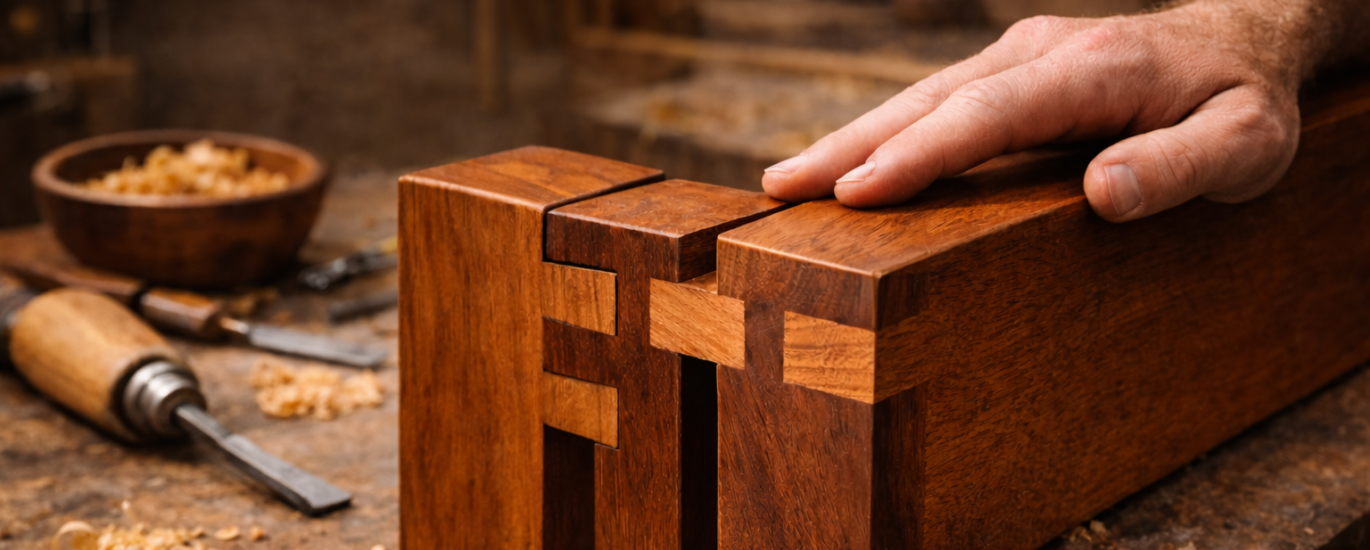
The Lindy Effect: This is a concept suggesting that the longer something has survived, the longer it is likely to survive. When you see a mortise and tenon joint—a technique used for thousands of years—your brain registers “safety” and “permanence.”
Tactile Trust: Human beings are tactile creatures. When a drawer slides out with a “woosh” instead of a rattle, your cortisol levels actually drop. It’s the “Premium Feel” heuristic.
Insight: We don’t just buy furniture; we buy the idea that our lives have a foundation. A wobbly table is a metaphor for a wobbly life. Signature joinery is the cure.
2. The “Living Wood” Factor: Seasonal Movement
The biggest mistake amateur builders make? Forgetting that wood breathes. A Master-Craftsman guarantee includes an understanding of hygroscopy. Wood expands in the summer (high humidity) and shrinks in the winter.
The Secret: Signature joinery allows for this movement. A “floating” tabletop or a breadboard end isn’t just a design choice; it’s an engineering necessity to prevent the wood from cracking itself apart.
3. Case Study: The “Heirloom” Test
Scenario A: Held together with metal L-brackets and screws. Over 5 years of kids leaning on it, the screws strip the soft particle board holes. The table starts to “sway.” Eventually, it’s firewood.
Scenario B: A Signature Joinery table. Every leg is joined with a pegged mortise and tenon. As the wood ages, the fibers tighten. After 50 years, the glue may dry out, but the mechanical lock keeps it standing. You give it to your grandkids.
Which one was actually cheaper in the long run?
4. How to Spot “Fake” Quality
Marketing is a powerful tool, and many brands use “dovetail” as a buzzword. Here’s how to be a savvy buyer:
Check the back: Are the dovetails only on the front of the drawer? Cheap move.
The “Rattle Test”: Shake the piece gently. If you hear a mechanical “click” or feel a shimmy, the joinery is loose.
The Finish: Look at the joints. Is there a glob of dried glue? A master cleans their joinery before it dries. Clean lines = High discipline.
5. The Ethical Angle: Sustainability
We don’t talk about this enough, but Signature Joinery is the ultimate green technology. Every time a piece of “disposable” furniture goes to a landfill, we lose the carbon stored in that wood and the energy used to ship it. A piece that lasts 100 years replaces 15-20 “cheap” pieces.
Frequently Asked Questions (FAQs)
Q: Is “Master-Craftsman” joinery always done by hand? A: Not necessarily! While hand-cutting shows incredible skill, modern masters use precision machinery (like CNC or high-end jigs) to achieve tolerances within 0.001 inches. The “Master” level refers to the design and fit, not just the tools used.
Q: Why is it so much more expensive? A: You’re paying for time and expertise. A dovetail drawer takes four times longer to build than a stapled one. You’re also paying for “insurance”—the guarantee that you won’t have to buy this item again in five years.
Q: Can I use wood glue on any joint? A: Glue is a supplement, not a crutch. A signature joint should hold its own weight before the glue is even applied. In woodworking, we say “The wood holds the load; the glue holds the wood.”
Q: How do I maintain these joints? A: Keep your home’s humidity stable (between 35-55%). Drastic swings in moisture are the only thing that can truly challenge a master-crafted joint.
The Verdict: You Get What You Join
Signature Joinery is the difference between a product and a legacy. It’s the “Master-Craftsman” guarantee that every time you sit down, lean back, or open a drawer, the laws of physics are working with you, not against you.
Don’t settle for furniture that’s just “hanging on.” Demand the strength of a signature.